
Searching Clay County Civil Dockets
Indiana MyCase / Odyssey Public Access is the free starting point for public Clay County civil docket information. Pick the Case, Name, or Attorney tab. A cause number gives the cleanest result. For a name search, start with a last name or business name, then add a first name, court, Civil, Family, or Probate filters, status, and a file-date range only as needed.
Both courts hold civil causes. Search 11C01 Clay Circuit Court and 11D01 Clay Superior Court whenever the case type or assignment is unclear. Be careful with birth dates, since that field may be absent from a civil record and can wrongly exclude a result. Results cap at 1,000. Also, sounds-like cannot be combined with a wildcard.
- Open MyCase and select Case, Name, or Attorney.
- Enter the exact cause number, or a party or business name.
- Narrow with 11C01 or 11D01 and the right case category.
- Open the result and verify type, filed date, parties, court, and status.
- Read the CCS in order and ask the clerk for any needed public document.
Clay Civil Tort Allocation
Under the Clay local allocation rule, CT civil tort filings split two-thirds to Circuit Court and one-third to Superior Court. The split is just routing. It says nothing about the claim's merit. PL civil plenary, MF mortgage foreclosure, CC collection, DC and DN domestic relations, MI miscellaneous civil, MH mental health, and RS reciprocal-support cases generally divide equally unless a more specific rule applies.
A cause number reveals the assigned court. Consider the format 11D01-2608-CT-000123, an illustration and not a real case. Clay and Superior come first, followed by the filing year and month, the type, and the sequence.
Inside a Clay Civil Docket
Think of the CCS as the running index of judicial events. It may show when a complaint or petition was filed, service issued, counsel appeared, a motion arrived, a conference or hearing was set, an order entered, judgment issued, or an appeal began. The pleading behind an entry is a separate thing. The CCS does not contain every filing.
| Header | Cause number, assigned court, case type, filed date, style, and status. |
|---|---|
| Parties | Plaintiff or petitioner, defendant or respondent, and public attorney appearances. |
| CCS | Dated pleadings, service, motions, hearings, orders, judgment, and appeal events. |
| RJO | Final judgments and other designated substantive orders. |
| Financial fields | Filing costs, judgment amount, payments, credits, or displayed balance. |
| Documents | Links only for public categories when an image was posted. |
Open, closed, and decided are portal statuses. They do not tell you who prevailed. For the actual result, read the judgment or final order, and get a certified copy when formal proof is needed.
Clay Civil Case Codes
Case-type codes are the fastest way to separate civil dockets. They also explain why a search limited to Civil can miss a Family or Probate result. These labels come from Indiana's uniform case-number system and Clay's assignment rule.
- PL and CT
- Civil plenary and civil tort.
- CC and MF
- Collection and mortgage foreclosure.
- SC and EV
- Small claims types assigned to Superior Court.
- DC and DN
- Domestic relations with or without children.
- PO and MH
- Protection order and mental-health matters, each with access concerns.
- AD, ES, EU, GU, TR
- Adoption, estate, guardianship, and trust types assigned to Circuit Court.
Juvenile and probate codes can route a matter to Circuit even though the same public portal performs the search. Seeing one in a result does not mean every document is open online.
Civil Case Types on the Docket
Clay County civil dockets cover tort, contract-style plenary matters, collections, foreclosures, family cases, small claims, estates, guardianships, trusts, protective orders, and related proceedings. One clerk serves both courts. Assignments, though, are not shared evenly.
| Case group | Clay court placement |
|---|---|
| SC and EV small claims | Superior Court |
| PO protective order | Superior unless related Circuit litigation is pending |
| Probate, estate, trust, guardianship, adoption | Circuit Court |
| CT tort | Two-thirds Circuit, one-third Superior |
| Other listed civil categories | Generally equal allocation |
There is no separate civil clerk or local civil-only search portal. The Clerk of the Clay Circuit and Superior Courts maintains all of these case records.
Clay CCS Versus Full Pleading
A CCS line may say a complaint, answer, motion, or order was filed without exposing the image itself. Which document categories can appear online is governed by Indiana's public-document matrix. Even when the clerk holds a paper or scanned record, older converted events may lack an image.
Missing image does not mean missing filing. Give the clerk the Clay cause number, document name, and CCS date when requesting a public copy.
The RJO is not the CCS. It preserves final judgments and designated orders, while the Judgment Docket concerns money judgments. Ask for the record that fits the need instead of requesting a vague "docket."
Civil Docket Settings and Hearings
A setting entry can name a conference or motion hearing. It can also list a bench or jury trial, small-claims hearing, probate event, or protective-order hearing. Another appearance may appear too. Clay currently supplies no participating court to Indiana's standalone Court Calendar. Read the newest CCS entry first. Then call 11C01 Circuit at 812-448-9036 or 11D01 Superior at 812-448-9031.
Expect a continuance or reset to add a later entry. The old date may remain in the historical CCS. Note that the entry date is when the clerk recorded an event. The text may name a different future hearing date. A transfer, reassignment, or special-judge order can also change who hears a matter. The case still goes on.
Family cases can add a local scheduling step. Clay's family rule adopts the Indiana Parenting Time Guidelines. It also calls for the Effective Parenting for Divorcing Couples Program before a final dissolution hearing involving unemancipated children, subject to waiver. That requirement may shape the filing and setting history. It does not mean a completion record or family document will be public in MyCase. Read the CCS, then ask the assigned court what remains due.
Clay Civil Filing Cost Context
Indiana's current fee manual sets an ordinary civil base at $157. Small claims sit at $97 and probate at $177. Add-ons stack quickly. Each extra named defendant may cost $10. A garnishee fee may add $10, and sheriff service runs $28 where requested. A CT or PL jury demand filed on or after July 1, 2023 carries a $75 jury fee.
Treat these numbers as a guide to cost entries. They are not a quoted balance for any case. Payments, waivers, service choices, and case-specific additions all change the total. So ask the clerk for a current Clay balance. E-filing sends documents through certified providers, but it is not a public civil docket database.
Civil Docket Access Rules
Indiana Access to Court Records Rule 4 favors public access. Rule 5 and other law set the limits. Adoption, mental-health, juvenile, protection-order, sealed, privileged, and personal-identifier material may be missing or redacted. MyCase also bars name searches for protection-order cases, since identifying information is protected. So an empty name search does not prove no order exists.
Clay access path: Search MyCase, call the assigned court for a live date, and request a public CCS, RJO, pleading, or certified copy from the clerk. Rule 9 governs requests for excluded records.
The Clay County Clerk's Office sits at 609 East National Avenue, Room 209, Brazil, IN 47834. The phone is 812-448-9024. A state directory lists Room 213 instead, so confirm before you visit. The clerk offers no general civil-copy form, public terminal, or mail, fax, email, or drop-box route. For portal fields and search fixes, see the Clay County case lookup.
Clay Civil Record Rules
Indiana Trial Rule 77 names the records the clerk keeps: the CCS, the RJO, the judgment docket, the indexes, and the case file.
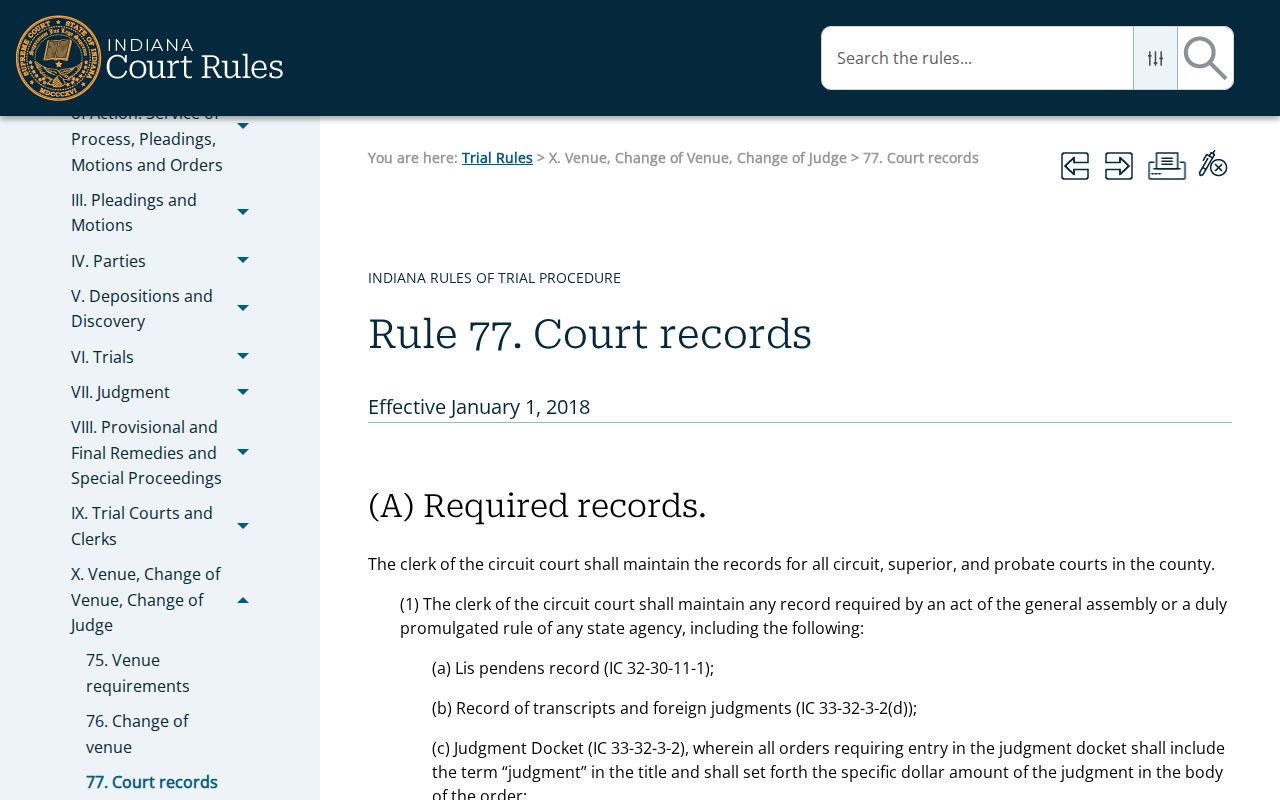
That distinction matters for a civil docket reading, because a Clay CCS entry and the pleading behind it are two separate records.
Indiana Administrative Rule 8 sets the uniform cause-number and case-type structure Clay uses.
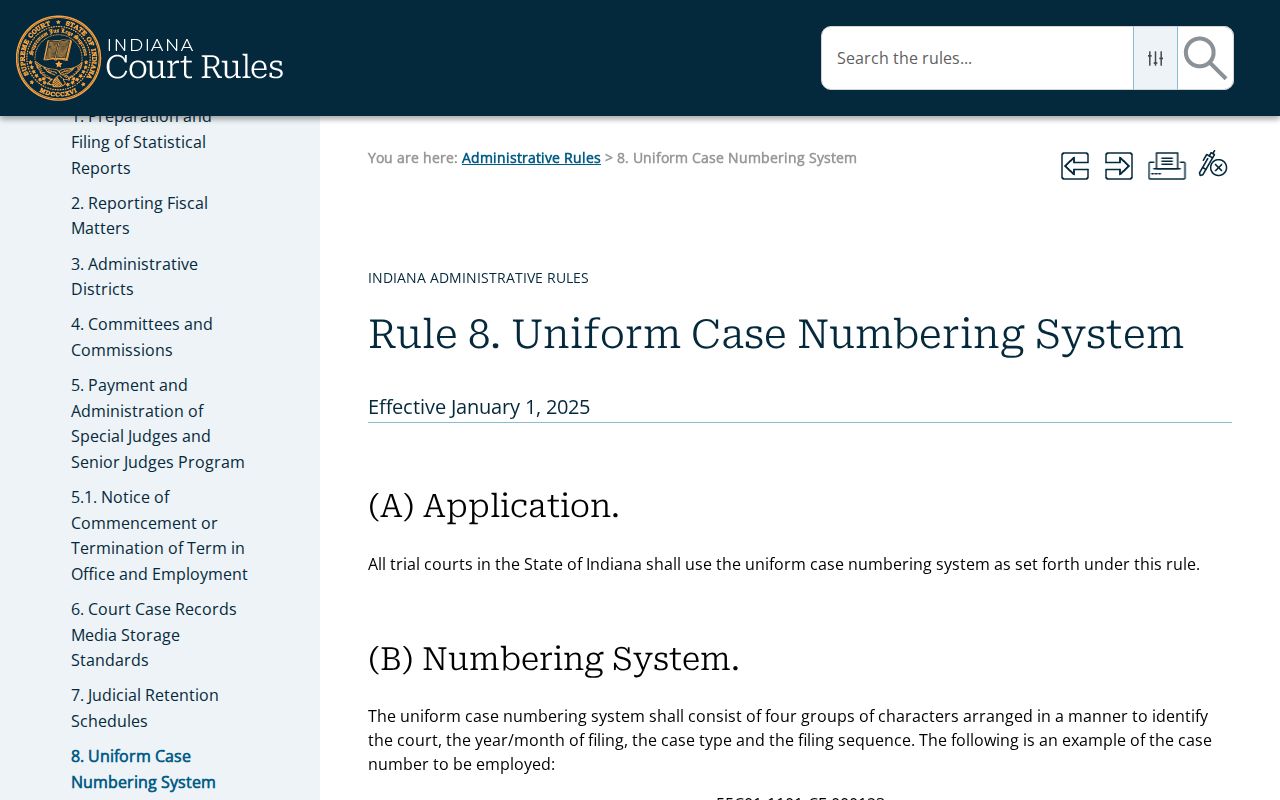
Those codes steer a search toward 11C01 or 11D01 and mark the civil case family.
The official e-filing workflow traces a filing from the provider through the statewide manager to the court system.
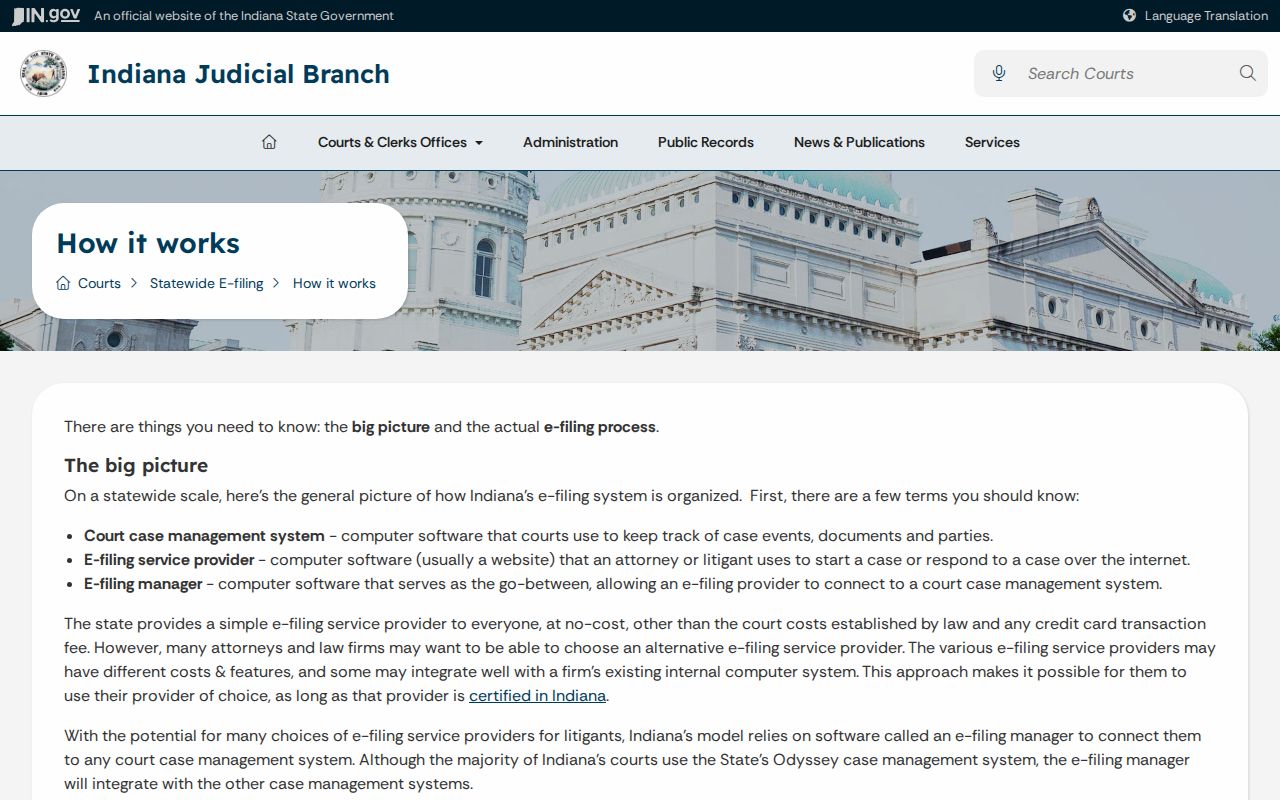
E-filing can create a CCS event, but it does not give the public a Clay civil docket search.